

About Ode to Hoary marmot
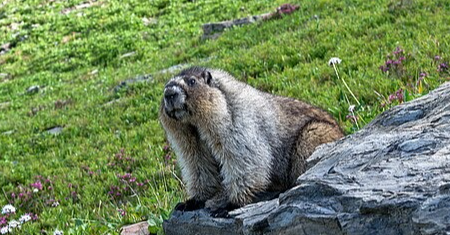
The hoary marmot (Marmota caligata) is a species of marmot that inhabits the mountains of northwest North America. Hoary marmots live near the tree line on slopes with grasses and forbs to eat and rocky areas for cover.
It is the largest North American ground squirrel and is often nicknamed "the whistler" for its high-pitched warning issued to alert other members of the colony to possible danger. The animals are sometimes called "whistle pigs". Whistler, British Columbia, originally London Mountain because of its heavy fogs and rain, was renamed after these animals to help make it more marketable as a resort.[2] The closest relatives of the species are the yellow-bellied, Olympic, and Vancouver Island marmots, although the exact relationships are unclear.[3][4]
Themes & SDGs Supported




Mission and Vision
The word "hoary" refers to the silver-gray fur on their shoulders and upper back; the remainder of the upper parts have drab- or reddish-brown fur. The head is black on the upper surface, with a white patch on the muzzle, white fur on the chin and around the lips, and grizzled black or brown fur elsewhere. The feet and lower legs are black, sometimes with white patches on the fore feet. Marmots have long guard hairs that provide most of the visible colour of their pelage, and a dense, soft underfur that provides insulation. The greyish underparts of the body lack this underfur, and are more sparsely haired than the rest of the body.[11] Hoary marmots moult in the early to mid summer.[5] The feet have slightly curved claws, which are somewhat larger on the fore feet than on the hind feet. The feet have hairless pads, enhancing their grip. The tail is long, slightly flattened, and covered with dense fur. Apart from the larger size of the males, both sexes have a similar appearance. Fema
Investment Terms
To view Terms/Materials, you must have a CataCap account and be logged in. Access to full materials is available to Donor/Investors with an active CataCap balance.
If you do not have an active balance, you may contact the company or fund directly using the “Questions about this investment?” link, or email [email protected] for assistance.
Investment Materials
To view Materials/Terms, you must have a CataCap account and be logged in. Access to full materials is available to Donor/Investors with an active CataCap balance.
If you do not have an active balance, you may contact the company or fund directly using the “Questions about this investment?” link, or email [email protected] for assistance.