


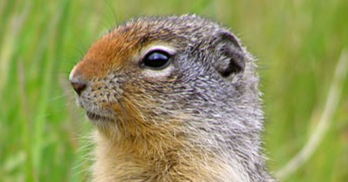
About Columbian ground squirrel
The Columbian ground squirrel (Urocitellus columbianus) is a species of rodent common in certain regions of Canada and the northwestern United States. It is the second largest member of the genus Urocitellus, which is part of the tribe Marmotini, along with marmots, chipmunks, prairie dogs, and other holarctic ground squirrels. They are stout, with short dense fur, which is characteristically tawny across the bridge of the nose. Social encounters sometimes are initiated with kissing behavior and the most common activity above ground is standing at attention. Residing in mountainous terrain and high plains in northern latitudes, they hibernate for 8 to 9 months of the year in burrows, which may be used for many years. They are emaciated when emerging in the spring. The Columbian ground squirrel came to the attention of the scientific community through writings produced by Lewis and Clark, while 21st century molecular genetics has more finely illuminated its ties with other close relatives.
Description
The Columbian ground squirrel is one of the largest members of the genus, the largest being the Arctic ground squirrel.[2] They have a relatively sturdy, robust build. They measure 325–410 mm (12.8–16.1 in) in length overall, with a tail measuring 80–116 mm (3.1–4.6 in). The hind feet measure 47–57 mm (1.9–2.2 in) and the ear 16–22.5 mm (0.63–0.89 in).
The hair is dense and relatively short. The facial fur is bronze across the bridge of the nose. The fur along the back, legs, and feet is a more cinnamon buff, with darker fur closer to the body. There is a pale beige to buff ring of fur around the eye. The neck fur is gray along the sides of the cheeks. The flanks may be light beige or gray. They have a darker tail, with darker underfur and some lighter beige markings above and dark to grayish white below.[2] Molting occurs diffusely, without a clear line of delineation.[2]
Two subspecies have been described, which vary in appearance. Compared with U. c. columbianus, the population U. c. ruficaudus has a tail more rufous and less gray above. The sides of the face and throat are also more deeply rust shaded. The legs and feet are darker as well.[2] The skull of U. c. ruficaudus is broader, with more robust zygomatic arches.[2]
Several albino variants have been found. An albino squirrel was captured alive by a student near Pullman, Washington in 1932. It had been in an alfalfa field. The animal had white hair and pink eyes. A zoologist reported intentions to keep the animal alive to study genetic inheritance patterns.[3] The following year, he reported finding three more young albinos in the same area.[4] Around 30 years prior, two albino skins had been collected, also near Pullman. It was proposed that the recessive trait persisted in the locality, appearing at sporadic intervals.[3]
Themes & SDGs Supported



Mission and Vision
Columbian ground squirrel
Investment Terms
To view Terms/Materials, you must have a CataCap account and be logged in. Access to full materials is available to Donor/Investors with an active CataCap balance.
If you do not have an active balance, you may contact the company or fund directly using the “Questions about this investment?” link, or email [email protected] for assistance.
Investment Materials
To view Materials/Terms, you must have a CataCap account and be logged in. Access to full materials is available to Donor/Investors with an active CataCap balance.
If you do not have an active balance, you may contact the company or fund directly using the “Questions about this investment?” link, or email [email protected] for assistance.