


About Celebrating Curlews
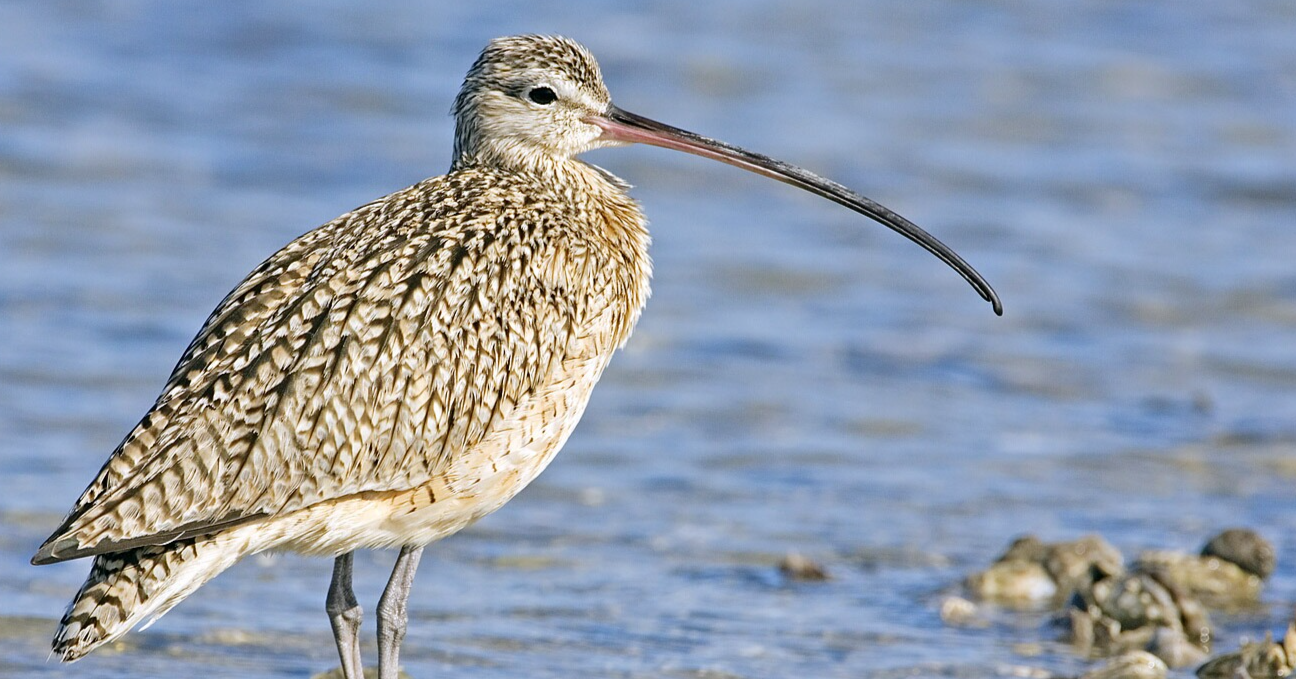
The curlews (/ˈkɜːrljuː/) are a group of eight species of birds in the genus Numenius, characterised by their long, slender, downcurved bills and mottled brown plumage. The English name is imitative of the Eurasian curlew's call, but may have been influenced by the Old French corliu, "messenger", from courir, "to run". It was first recorded in 1377 in Langland's Piers Plowman "Fissch to lyue in þe flode..Þe corlue by kynde of þe eyre".[1] In Europe, "curlew" usually refers to one species, the Eurasian curlew (Numenius arquata).
Taxonomy
The genus Numenius was erected by the French scientist Mathurin Jacques Brisson in his Ornithologie published in 1760.[2] The type species is the Eurasian curlew (Numenius arquata).[3] The Swedish naturalist Carl Linnaeus had introduced the genus Numenius in the 6th edition of his Systema Naturae published in 1748,[4] but Linnaeus dropped the genus in the important tenth edition of 1758 and put the curlews together with the woodcocks in the genus Scolopax.[5][6] As the publication date of Linnaeus's sixth edition was before the 1758 starting point of the International Commission on Zoological Nomenclature, Brisson and not Linnaeus is considered as the authority for the genus.[7] The name Numenius is from Ancient Greek noumenios, a bird mentioned by Hesychius. It is associated with the curlews because it appears to be derived from neos, "new" and mene, "moon", referring to the crescent-shaped bill.[8] The genus now contains nine species:[9]
They are one of the most ancient lineages of scolopacid waders, together with the godwits which look similar but have straight bills.[11] Curlews feed on mud or very soft ground,[12][13] searching for worms and other invertebrates with their long bills. They will also take crabs and similar items.
Themes & SDGs Supported





Mission and Vision
The Late Eocene (Montmartre Formation, some 35 mya) fossil Limosa gypsorum of France was originally placed in Numenius and may in fact belong there.[19] Apart from that, a Late Pleistocene curlew from San Josecito Cave, Mexico has been described.[20] This fossil was initially placed in a distinct genus, Palnumenius, but was actually a chronospecies or paleosubspecies related to the long-billed curlew. The upland sandpiper (Bartramia longicauda) is an odd bird which is the closest relative of the curlews.[11] It is distinguished from them by its yellow legs, long tail, and shorter, less curved bill.
Investment Terms
To view Terms/Materials, you must have a CataCap account and be logged in. Access to full materials is available to Donor/Investors with an active CataCap balance.
If you do not have an active balance, you may contact the company or fund directly using the “Questions about this investment?” link, or email [email protected] for assistance.
Investment Materials
To view Materials/Terms, you must have a CataCap account and be logged in. Access to full materials is available to Donor/Investors with an active CataCap balance.
If you do not have an active balance, you may contact the company or fund directly using the “Questions about this investment?” link, or email [email protected] for assistance.